What is the Process Flow of a Dissolved Air Flotation Unit
The Dissolved Air Flotation (DAF) system follows a fully integrated process chain:
Pretreatment → Reaction → Mixing → Separation → Post-treatment. Each stage is designed to efficiently remove suspended solids, oils, and other contaminants from wastewater. The detailed steps are as follows: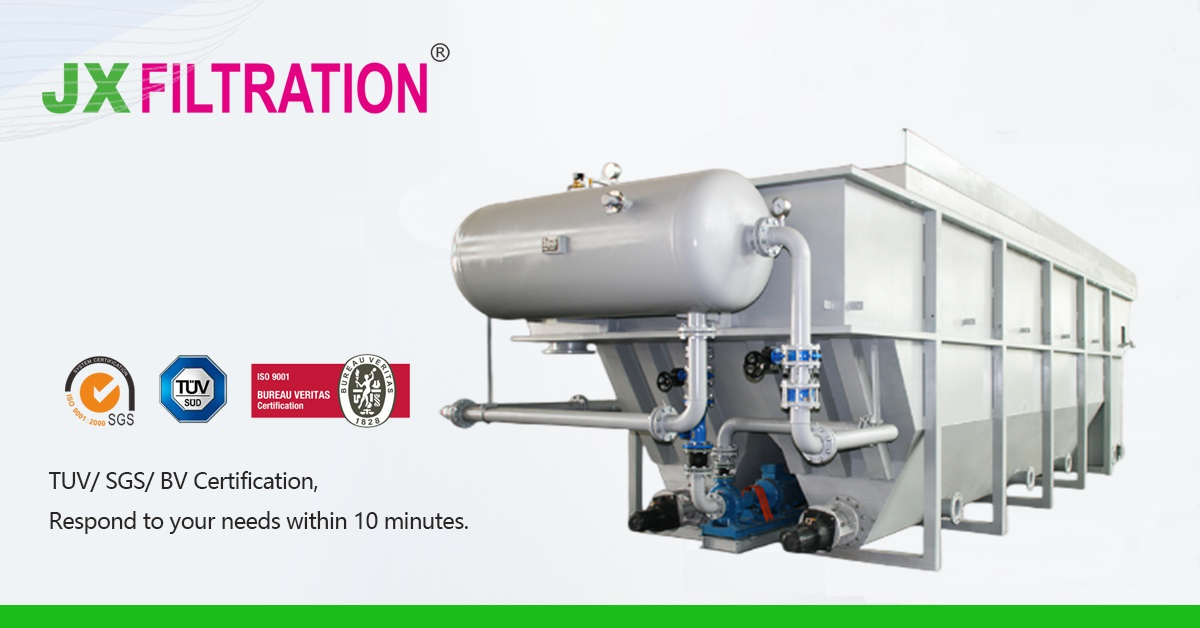
1. Influent Pretreatment
Raw wastewater first passes through screens, filters, or other preliminary treatment devices. These remove large particles such as stones, debris, and fibrous materials. This step is critical to prevent clogging or damage to core components of the DAF unit, especially the air dissolution pump and the release device.
2. Flocculation Reaction
After pretreatment, the wastewater enters the flocculation stage, where coagulant (PAC) and flocculant (PAM) are added. Through gentle mixing, these chemicals cause fine suspended solids and colloidal impurities to aggregate into larger, denser floc particles. This floc formation greatly enhances the efficiency of subsequent air attachment.
3. Air Dissolution & Mixing
The flocculated wastewater first flows into a flow stabilization chamber, where turbulent kinetic energy is dissipated to ensure a uniform flow pattern. It then moves into the air dissolution release chamber, where it is thoroughly mixed with saturated dissolved air water. When the pressure is released, millions of micro-bubbles are generated. These bubbles rapidly and tightly adsorb onto the floc particles, reducing their overall density.
4. Flotation Separation
The bubble-laden floc particles, now lighter than water, rise slowly to the surface of the DAF tank, forming a stable sludge layer. Meanwhile, the treated, clarified water is discharged from a collection pipe located at the bottom of the tank. This gravity-based separation is continuous and highly efficient.
5. Sludge Handling (Post-treatment)
A rotating scraper mechanism evenly removes the floating sludge from the water surface and directs it into a sludge hopper. The collected sludge is then transferred to dewatering equipment, such as a plate and frame filter press. Dewatering significantly reduces the volume of solid waste, lowering disposal costs and making the sludge easier to handle or incinerate.
This complete DAF process ensures reliable solid-liquid separation, protects downstream equipment, and produces clean effluent suitable for further treatment or direct discharge.
Any requirements, contact us now!
Grace
Email: grace@filtrationchina.com
Mobile/WhatsApp/WeChat: +86 17269571160