How a Horizontal Centrifuge Works: Principles of Separation
The purpose of separation is to isolate solid particles from a mixture or to separate two immiscible liquids with different specific gravities. In a container holding a mixture of light liquid, heavy liquid, and solid particles, stratification will naturally occur after a period of settling under the influence of gravity. The solid particles, having the highest specific gravity, sink to the bottom. The light liquid rises to the top, while the heavy liquid remains in the middle layer.
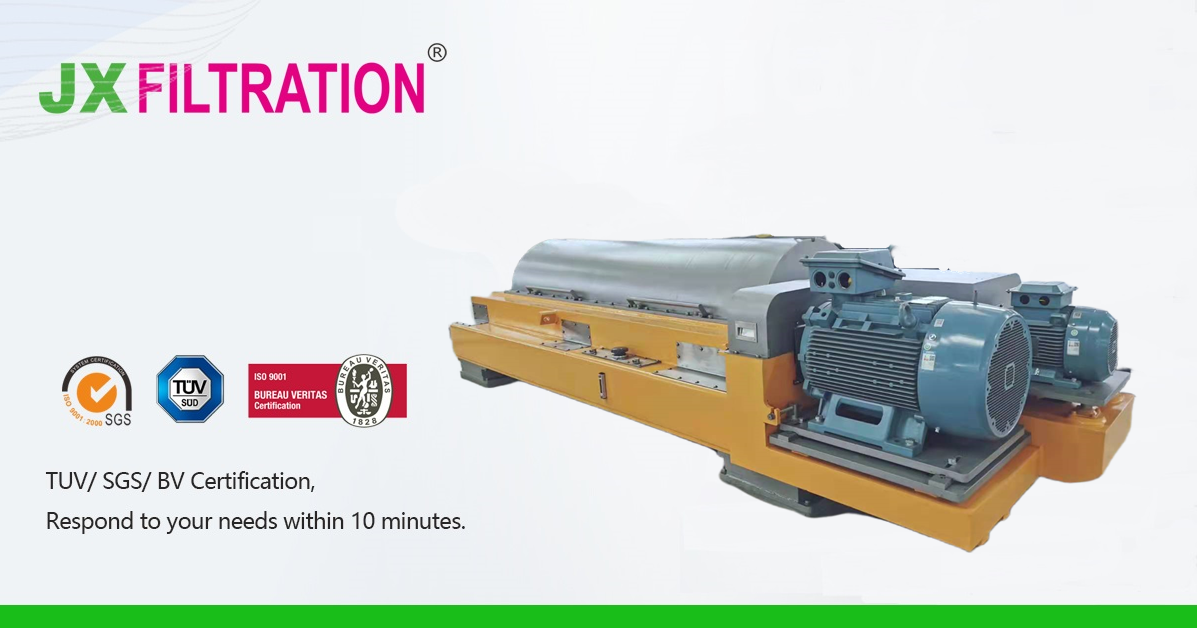
When this mixture enters a horizontal centrifuge drum and rotates at high speed, the stratification process is dramatically accelerated by the centrifugal force field. This acceleration can be several thousand times faster than natural gravity-driven settling, with the separation factor representing the multiple of gravitational acceleration.
Within the rapidly rotating drum, solid particles—due to their higher specific gravity—experience a greater centrifugal force and are rapidly thrown outward, settling against the inner wall of the drum. The liquid phase, being less dense, is displaced toward the center. In cases where both light and heavy liquid phases are present, the heavy phase collects closer to the drum wall, while the light phase gathers nearer to the center.
The design of the centrifuge includes specific outlets depending on the application. In a two-phase separator, there is an overflow port for the liquid phase and a separate outlet for solids. In a three-phase separator, there are separate outlets for the light liquid, heavy liquid, and solids.
The centrifuge is equipped with a feed inlet and a screw feeder, enabling continuous operation. During the separation process, material enters the centrifuge through a feed pipe. Inside the high-speed rotating drum, solids are thrown to the drum wall, while liquid is directed toward the center. The solid material accumulated on the drum wall is then conveyed by a screw conveyor to the slag outlet and discharged from the machine. The separated liquid exits through overflow holes located at the large end of the drum.
A key component in this process is the differential, which ensures a stable differential speed between the drum and the screw conveyor. The system is further enhanced by a dual-frequency conversion speed control device that shares a common bus. This setup allows for stepless adjustment of both the drum speed and the differential speed. As a result, the centrifuge can adapt to variations in flow rate and material concentration, automatically adjusting the differential speed to maintain optimal separation performance.
Any requirements, contact us now!
Grace
Email: grace@filtrationchina.com
Mobile/WhatsApp/WeChat: +86 17269571160